Checked
History of Edmonton, Alberta
Edmonton, Alberta, Canada
The history of Edmonton, Alberta from thousands of years of Indigenous life on the North Saskatchewan River through Treaty 6, Fort Edmonton, becoming Alberta's capital, the Leduc oil boom and the 1987 tornado.
Key information
Indigenous peoples have lived and met along the North Saskatchewan River at Edmonton for thousands of years, and the city lies in Treaty 6 territory, signed in 1876, and the homeland of the Métis. Fort Edmonton was founded by the Hudson's Bay Company in 1795, Edmonton became a city in 1904 and the capital of the new province of Alberta in 1905.
On this page
Indigenous peoples on the North Saskatchewan
The river valley's water, timber and wildlife have drawn people for thousands of years. In 1976 archaeologists found a large campsite with stone tools dating from roughly 3000 to 500 BCE on a bluff above the North Saskatchewan, likely a regular meeting place for bands of hunters and gatherers.
The Edmonton area is the traditional territory of many nations. The Canadian Encyclopedia names the Blackfoot Confederacy, Tsuut'ina, Stoney Nakoda, Cree and Métis peoples. The City of Edmonton's land acknowledgement thanks the nêhiyaw (Cree), Dene, Anishinaabe (Saulteaux), Nakota Isga (Nakota Sioux) and Niitsitapi (Blackfoot) peoples, recognizes Edmonton as the Métis homeland, and notes that the city is home to one of the largest Inuit communities south of the 60th parallel.
Sources: Edmonton, The Canadian Encyclopedia · Indigenous Relations Office and land acknowledgement, City of Edmonton
Treaty 6
Edmonton is in Treaty 6 territory. The treaty was signed by Crown representatives and Cree, Assiniboine and Ojibwe leaders on August 23, 1876, at Fort Carlton and on September 9, 1876, at Fort Pitt, both in what is now Saskatchewan. Its boundaries cover much of central Alberta and Saskatchewan. The nations pushed for a treaty to protect their lands from outside settlement and because the bison they relied on were disappearing.
The City of Edmonton marks Treaty No. 6 Recognition Day each August 23 and uses a land acknowledgement that begins by recognizing that the city is in Treaty Six Territory.
Sources: Treaty 6, The Canadian Encyclopedia · Indigenous Relations Office and land acknowledgement, City of Edmonton
Fort Edmonton and the fur trade
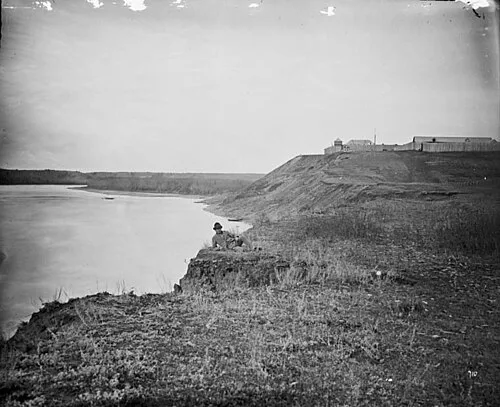
In 1795 the Hudson's Bay Company built a fortified trading post on the North Saskatchewan near today's Fort Saskatchewan, right beside a rival post of the North West Company. After the two companies merged in 1821, Fort Edmonton became the leading centre of the western fur trade. Severe flooding pushed the fort to higher ground in 1830, on the site where the Alberta Legislature now stands.
From 1826 to 1853 the fort was run by the colourful chief factor John Rowand, and artist Paul Kane painted it in 1846. The fort was reputedly named after Edmonton, near London, England, the birthplace of a deputy governor of the company. After the company gave up Rupert's Land in 1869 and 1870, the fort slowly declined and was taken down in 1915.
Sources: Fort Edmonton, The Canadian Encyclopedia · Edmonton, The Canadian Encyclopedia
From trading post to capital city
Settlement outside the fort was slow. A municipal count found just 148 people in 1878. The Canadian Pacific Railway went through Calgary in 1883, and when a branch line came north in 1891 it ended at Strathcona, on the south bank, leaving Edmonton across the river. Edmonton did not get its own transcontinental railway, the Canadian Northern, until 1905.
Edmonton was incorporated as a city in 1904. A year later, when Alberta became a province, it was chosen as the capital. The University of Alberta opened in 1908, and on February 1, 1912, Edmonton and Strathcona merged. The combined city boomed: the population jumped from 24,900 in 1911 to 72,516 in 1914, then fell to 53,846 by 1916 during the First World War.
For the next 25 years Edmonton rose and fell with farm prices. By 1941 it was still a modest city of about 94,000, though it had become an important air transport hub for bush flying into the North.
Sources: Edmonton, The Canadian Encyclopedia · Edmonton facts and figures, City of Edmonton · University of Alberta, The Canadian Encyclopedia
War, oil and rapid growth
The Second World War changed Edmonton. It became a strategic centre for northern military operations, including building the Alaska Highway. Then on February 13, 1947, the Leduc No. 1 well southwest of the city struck the huge Leduc oil field, followed by the Redwater and Pembina fields. Edmonton became the main centre for oil refining and petrochemicals in Canada.
From the 1940s to the early 1980s Edmonton was one of the fastest-growing cities in the country, and by 1981 its metropolitan area was the fifth largest in Canada. The city annexed Beverly in 1961 and Jasper Place in 1964, and grew to 521,205 people by 1981.
Sources: Edmonton, The Canadian Encyclopedia · Leduc, The Canadian Encyclopedia · Edmonton facts and figures, City of Edmonton
Modern milestones
Edmonton opened Canada's first light rail line in a medium-sized city and hosted the Commonwealth Games in 1978. West Edmonton Mall opened in 1981, the Fringe Festival began in 1982, and the Oilers won their first Stanley Cup in 1984, the first of five.
On Friday, July 31, 1987, an F4 tornado tore through the city's east side, including Mill Woods, the refinery area known as Refinery Row and the Evergreen Mobile Home Park in Clareview. It killed 27 people, injured at least 300 and destroyed more than 300 homes. Remembered as Black Friday, it remains the deadliest tornado in Alberta's history and led to improvements in Canada's weather radar and emergency warnings.
The city passed one million people in the 2021 Census, and Alberta's statistics office estimated about 1,238,295 residents by July 1, 2025. Andrew Knack became Edmonton's 37th mayor on October 29, 2025.
Sources: Edmonton, The Canadian Encyclopedia · West Edmonton Mall, The Canadian Encyclopedia · About Fringe Theatre, Edmonton International Fringe Theatre Festival · Edmonton Oilers, The Canadian Encyclopedia · Edmonton Tornado (1987), The Canadian Encyclopedia · Municipal population estimates 2016 to 2025, Alberta Office of Statistics and Information · Mayor and City Councillors, City of Edmonton
Historic places you can still visit
- Fort Edmonton Park, a 64-hectare living history museum with a rebuilt 1846 fort and streets of 1885, 1905 and 1920.
- The Alberta Legislature Building, near the site of the last Fort Edmonton.
- Old Strathcona, the main street of the former town of Strathcona and a protected conservation area.
- Government House and the Fairmont Hotel Macdonald, older landmarks that still stand out on the riverbank.
- Commonwealth Stadium, built for the 1978 Commonwealth Games.
Sources: Fort Edmonton Park, City of Edmonton · Fort Edmonton, The Canadian Encyclopedia · Edmonton, The Canadian Encyclopedia
Edmonton history timeline
| Year | Event |
|---|---|
| 3000 to 500 BCE | Campsite on a river bluff shows long Indigenous use of the area |
| 1795 | Hudson's Bay Company builds the first Fort Edmonton |
| 1821 | HBC and North West Company merge; Fort Edmonton leads the western fur trade |
| 1830 | Fort moves to higher ground near today's Legislature |
| 1876 | Treaty 6 is signed at Fort Carlton and Fort Pitt |
| 1891 | Railway from Calgary reaches Strathcona |
| 1904 | Edmonton is incorporated as a city |
| 1905 | Edmonton becomes the capital of Alberta |
| 1908 | University of Alberta opens |
| 1912 | Edmonton and Strathcona merge |
| 1947 | Leduc No. 1 strikes oil |
| 1978 | LRT opens and Edmonton hosts the Commonwealth Games |
| 1981 | West Edmonton Mall opens |
| 1984 | Oilers win their first Stanley Cup |
| 1987 | Black Friday tornado kills 27 people |
| 2016 | Anthony Henday Drive ring road is completed |
| 2021 | Census counts more than one million residents |
Sources: Edmonton, The Canadian Encyclopedia · Fort Edmonton, The Canadian Encyclopedia · Treaty 6, The Canadian Encyclopedia · Edmonton facts and figures, City of Edmonton · University of Alberta, The Canadian Encyclopedia · Leduc, The Canadian Encyclopedia · West Edmonton Mall, The Canadian Encyclopedia · Edmonton Oilers, The Canadian Encyclopedia · Edmonton Tornado (1987), The Canadian Encyclopedia
Questions about Edmonton history
When was Edmonton founded?
The first Fort Edmonton was built by the Hudson's Bay Company in 1795. Edmonton was incorporated as a city in 1904.
When did Edmonton become the capital of Alberta?
Edmonton was chosen as the capital when the province of Alberta was created in 1905, a year after it became a city.
What treaty is Edmonton on?
Edmonton is in Treaty 6 territory. Treaty 6 was signed in August and September 1876 at Fort Carlton and Fort Pitt by Crown representatives and Cree, Assiniboine and Ojibwe leaders.
Whose traditional land is Edmonton on?
The City of Edmonton acknowledges Treaty Six Territory and the nêhiyaw (Cree), Dene, Anishinaabe (Saulteaux), Nakota Isga (Nakota Sioux) and Niitsitapi (Blackfoot) peoples, and recognizes Edmonton as the Métis homeland.
Source: Indigenous Relations Office and land acknowledgement, City of Edmonton
Where was the original Fort Edmonton?
The first post was built in 1795 near today's Fort Saskatchewan. After floods, the fort was rebuilt in 1830 on higher ground near where the Alberta Legislature now stands.
When did Edmonton and Strathcona merge?
Edmonton and Strathcona amalgamated on February 1, 1912.
What was the population of Edmonton in 1901?
Edmonton had 2,626 people in the 1901 census. By 1914 the municipal census counted 72,516.
When was the Edmonton tornado?
The Black Friday tornado struck on July 31, 1987. It killed 27 people and is the deadliest tornado in Alberta's history.
When did the Oilers win the Stanley Cup?
The Oilers won their first Stanley Cup in 1984 and have won five in total.
When did Edmonton reach one million people?
The 2021 Census was the first to count more than one million people in Edmonton, at 1,010,899.