Checked
About Edmonton, Alberta: what to know about the capital
Edmonton, Alberta, Canada
A plain guide to Edmonton, Alberta's capital: where it is, how many people live there, the river valley, LRT and buses, the economy, winter weather, hospitals, schools and landmarks.
Key information
Edmonton is the capital of Alberta, built on both banks of the North Saskatchewan River near the geographic centre of the province, and is often called the Gateway to the North. The 2021 Census counted 1,010,899 people, and Alberta's statistics office estimates the city had about 1,238,295 residents on July 1, 2025.
On this page
Where is Edmonton?
Edmonton sits on the North Saskatchewan River near the geographic centre of Alberta. It has long been called the Gateway to the North because it lies between the rich farmland of central Alberta and the huge, resource-rich north, and it is the main supply and service centre for a territory that reaches all the way to the Arctic Ocean.
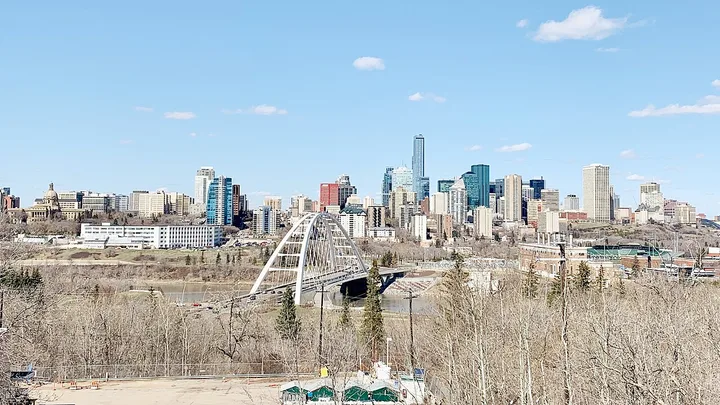
The river valley is the city's defining feature. It cuts through the middle of Edmonton and is lined with parks, trails, golf courses and woodland, crossed by many bridges. Downstream to the northeast lies Fort Saskatchewan, and Edmonton International Airport sits to the south near Leduc.
Sources: Edmonton, The Canadian Encyclopedia · River Valley Parks, City of Edmonton
How many people live in Edmonton?
| Year | Population | Source |
|---|---|---|
| 1901 | 2,626 | Census |
| 1941 | 93,924 | Census |
| 1981 | 521,205 | Census |
| 2016 | 933,088 | Census |
| 2019 | 972,223 | City municipal census |
| 2021 | 1,010,899 | Census |
| 2024 | 1,197,770 | Alberta estimate, July 1 |
| 2025 | 1,238,295 | Alberta estimate, July 1 |
Edmonton passed one million residents in the 2021 Census, which counted 1,010,899 people, up from 933,088 in 2016. Growth then accelerated. Alberta's Office of Statistics and Information estimates the city reached 1,197,770 people on July 1, 2024, and 1,238,295 on July 1, 2025. The City's own last municipal census, in 2019, counted 972,223 people.
Edmonton is diverse. In the 2021 Census, 42.8 per cent of residents identified as visible minorities, with South Asian, Chinese, Black and Filipino residents the largest groups, and 5.8 per cent identified as Indigenous, a large share for a Canadian city. The City's land acknowledgement notes that Edmonton is home to one of the largest Inuit communities south of the 60th parallel.
Sources: Edmonton facts and figures, City of Edmonton · Municipal census, City of Edmonton · Municipal population estimates 2016 to 2025, Alberta Office of Statistics and Information · Edmonton, The Canadian Encyclopedia · Indigenous Relations Office and land acknowledgement, City of Edmonton
Main areas and neighbourhoods
Downtown sits on the north bank of the river, near the Alberta Legislature, Government House and the Macdonald Hotel, three older landmarks that still stand out on the riverbank. Across the river, Old Strathcona grew up as the separate town of Strathcona, where the railway from Calgary ended in 1891. Its old main street survived the city's many rebuilds and is protected today as part of the Old Strathcona conservation area.
Beyond the core, Edmonton spread out quickly after the Second World War, growing from 110 square kilometres in 1941 to 684.4 square kilometres by 2011. Large planned districts such as Mill Woods in the south and Clareview in the northeast grew in later decades, and new suburbs keep spreading toward and beyond Anthony Henday Drive. The City's census reports results for every one of its neighbourhoods.
Sources: Edmonton, The Canadian Encyclopedia · Municipal census, City of Edmonton · Edmonton Tornado (1987), The Canadian Encyclopedia
How people get around Edmonton
Edmonton Transit Service (ETS) runs buses and three LRT lines. The Capital Line runs from Clareview in the northeast to Century Park in the south, the Metro Line runs from NAIT/Blatchford Market to Health Sciences/Jubilee, and the Valley Line runs southeast from downtown to Mill Woods. Edmonton was the first medium-sized Canadian city to build light rail, opening its first line in 1978.
As of February 1, 2026, an adult trip costs $3 with an Arc card or a tap of a credit or debit card, or $3.75 in cash, and is valid for 90 minutes. Arc card fares stop at $10.50 a day and $66 a month. Children 12 and under ride free with a paying rider.
Most people still drive. Anthony Henday Drive, a freeway ring road around the city, was completed in 2016, and Edmonton sits where the Yellowhead Highway meets the Queen Elizabeth II Highway to Calgary. Edmonton International Airport opened in 1957; the old airport near downtown opened in 1927 and closed in 2013.
Sources: LRT station locations, City of Edmonton · ETS fares, City of Edmonton · Edmonton, The Canadian Encyclopedia
Edmonton's economy and major employers
Edmonton's economy has always run on natural resources. It is the main location of oil refining and the petrochemical industry in Canada, and it supplies and services the oil sands, conventional oilfields, forestry, farming and northern mining. Refineries and chemical plants stretch along the river valley northeast toward Fort Saskatchewan, the largest industrial region in Alberta.
As the provincial capital, Edmonton is also a major centre of government jobs, both provincial and federal. The University of Alberta, health care, construction, engineering and technology are large parts of the economy, and the Canadian Forces base known locally as the Edmonton Garrison has been a major military base since the 1990s. EPCOR, the power and water company, is owned by the City of Edmonton as its sole shareholder.
Sources: Edmonton, The Canadian Encyclopedia
Weather and climate in plain numbers
| Month | Average daily high | Average daily low | Precipitation |
|---|---|---|---|
| January | -6.0°C | -14.8°C | 21.7 mm |
| April | 11.2°C | -0.5°C | 28.8 mm |
| July | 23.1°C | 12.3°C | 93.8 mm |
| October | 10.4°C | -0.2°C | 21.7 mm |
| Whole year | 9.3°C | -1.0°C | 455.7 mm (123.5 cm of snow) |
Edmonton has cold, dry winters and warm, fairly wet summers. At the old City Centre Airport station, the average January day reaches about minus 6 degrees Celsius and drops to about minus 15 overnight. In July the average high is about 23 degrees and the average low about 12. July is the wettest month, with about 94 mm of rain, and the city gets about 124 cm of snow a year.
The City's coat of arms even includes a sun to represent Edmonton's above-average sunshine, which helps on a minus 20 morning.
Sources: Canadian Climate Normals 1981 to 2010, Edmonton City Centre Airport, Environment and Climate Change Canada · Edmonton facts and figures, City of Edmonton
Hospitals, colleges and universities
Edmonton's main hospitals include the University of Alberta Hospital and the Stollery Children's Hospital (both with 24-hour emergency departments), the Royal Alexandra Hospital, and the Grey Nuns and Misericordia community hospitals run by Covenant Health. For advice that is not an emergency, call Health Link at 811.
The University of Alberta, founded in 1908, is one of Canada's largest research universities. The Northern Alberta Institute of Technology (NAIT) and MacEwan University are the other big post-secondary schools. Most children attend Edmonton Public Schools or Edmonton Catholic Schools; the school registration guide explains how to sign up.
Sources: Edmonton Zone facilities map, Alberta Health Services · University of Alberta, The Canadian Encyclopedia · Edmonton, The Canadian Encyclopedia
Landmarks and what Edmonton is known for
| Landmark | What it is | Good to know |
|---|---|---|
| Alberta Legislature Building | Seat of Alberta's government | Built near the site of the last Fort Edmonton |
| West Edmonton Mall | Giant shopping and entertainment centre | Held the Guinness record as the world's largest mall for 24 years |
| Muttart Conservatory | Four glass pyramids in the river valley | About 700 kinds of plants |
| Fort Edmonton Park | Living history museum on 64 hectares | Recreates the 1846 fort and streets of 1885, 1905 and 1920 |
| North Saskatchewan River valley | Chain of parks and trails through the city | William Hawrelak Park alone covers 68 hectares |
| Old Strathcona | Historic main street south of the river | Former town of Strathcona, merged with Edmonton in 1912 |
| Rogers Place | Downtown arena | Home of the Edmonton Oilers |
| Commonwealth Stadium | Outdoor stadium | Built for the 1978 Commonwealth Games; home of the Elks |
Edmonton is known as Canada's Festival City, as the home of West Edmonton Mall and the Edmonton Oilers, and as the province's centre of government. It hosts dozens of festivals a year, led by the Edmonton International Fringe Theatre Festival, the Folk Music Festival and the 10-day K-Days exhibition, which traces its roots to an 1879 agricultural fair.
Sources: Edmonton, The Canadian Encyclopedia · West Edmonton Mall, The Canadian Encyclopedia · Muttart Conservatory, City of Edmonton · Fort Edmonton Park, City of Edmonton · River Valley Parks, City of Edmonton · Edmonton Oilers, The Canadian Encyclopedia · About Fringe Theatre, Edmonton International Fringe Theatre Festival
Who runs the city?
Edmonton City Council has 13 members: a mayor elected by the whole city and 12 councillors, each representing a ward. Andrew Knack was sworn in as Edmonton's 37th mayor on October 29, 2025. City services such as transit, roads, waste and recreation start with 311.
Questions about Edmonton
What is the population of Edmonton?
The 2021 Census counted 1,010,899 people in Edmonton. Alberta's Office of Statistics and Information estimates the population was 1,238,295 on July 1, 2025.
Source: Municipal population estimates 2016 to 2025, Alberta Office of Statistics and Information
Is Edmonton the capital of Alberta?
Yes. Edmonton was chosen as the capital when Alberta became a province in 1905.
Why is Edmonton called the Gateway to the North?
Edmonton sits between central Alberta's farmland and the resource-rich north, and it has long been the supply and service centre for a territory stretching to the Arctic Ocean.
What is Edmonton known for?
Edmonton is known for West Edmonton Mall, the Edmonton Oilers, its many festivals (it is nicknamed Canada's Festival City), the North Saskatchewan River valley and its role as Alberta's capital.
How cold does Edmonton get in winter?
Based on 1981 to 2010 climate normals at the City Centre Airport, the average January high is about minus 6 degrees Celsius and the average low about minus 15.
How much is a bus or LRT fare in Edmonton?
As of February 1, 2026, an adult ETS fare is $3 with an Arc card or tap payment, or $3.75 in cash, valid for 90 minutes. Arc fares are capped at $10.50 a day and $66 a month.
Source: ETS fares, City of Edmonton
How many LRT lines does Edmonton have?
Edmonton has three LRT lines: the Capital Line, the Metro Line and the Valley Line.
What are the main hospitals in Edmonton?
Main hospitals include the University of Alberta Hospital, the Stollery Children's Hospital, the Royal Alexandra Hospital, and the Grey Nuns and Misericordia community hospitals.
Source: Edmonton Zone facilities map, Alberta Health Services
Who is the mayor of Edmonton?
Andrew Knack was sworn in as the 37th mayor of Edmonton on October 29, 2025.
What are the major industries in Edmonton?
Oil refining and petrochemicals, services for the oil sands and other northern industries, government, the University of Alberta, construction, engineering and technology are among Edmonton's largest industries.