Checked
Fun facts about Edmonton, Alberta
Edmonton, Alberta, Canada
Twenty-two verified fun facts about Edmonton, Alberta, from the world's former largest mall and North America's biggest fringe festival to a mayor's chain on a beaver pelt.
Key information
Edmonton was home to the world's largest shopping mall for 24 years, runs North America's largest and longest-running fringe theatre festival, and was the first medium-sized city in Canada to build light rail (1978). It is also the birthplace of Michael J. Fox and Nathan Fillion, and it is reputedly named after a district of London, England.
On this page
Names and civic symbols
1. Edmonton is reputedly named after part of London. The fur trade post was said to be named for Edmonton, then a village near London and now part of the city, the birthplace of a deputy governor of the Hudson's Bay Company.
2. The mayor's chain rests on a beaver pelt. The Mayor's Chain of Office, worn at ceremonies, sits on a prime beaver pelt to recognize Edmonton's start as a Hudson's Bay Company trading post.
3. The official flower is a nod to the gold rush. Edmonton's official flower is the marigold, which the City says represents sunny Alberta and Edmonton's role in the Klondike Gold Rush of the 1890s.
4. The coat of arms brags about the weather. The sun on the City's shield stands for Edmonton's above-average amount of sunshine, and a winged wheel stands for its history as an aviation and industrial centre.
Sources: Edmonton, The Canadian Encyclopedia · Edmonton facts and figures, City of Edmonton
Booms, busts and a city that merged with its neighbour
5. Edmonton grew almost 28 times over in 13 years. Municipal and federal counts show 2,626 people in 1901 and 72,516 in 1914. Then the bust hit: by 1916 the population had fallen to 53,846.
6. Old Strathcona used to be a rival town. When the railway from Calgary arrived in 1891 it stopped at Strathcona, on the south bank, instead of Edmonton. The two towns merged on February 1, 1912.
7. The city is about six times the size it was in 1941. Edmonton covered 110 square kilometres in 1941 and 684.4 square kilometres by 2011, much of it on some of Alberta's richest farmland.
8. The City once owned the phone company. Edmonton ran its own utilities from the 1890s. Its telephone system was later sold, and its power and water utilities became EPCOR, which the City still owns as sole shareholder.
Sources: Edmonton facts and figures, City of Edmonton · Edmonton, The Canadian Encyclopedia
Big places and records
9. West Edmonton Mall was the world's largest mall for 24 years. It covers 49 hectares and encloses 493,000 square metres, about the size of 104 football fields, and Guinness listed it as the world's largest shopping centre for 24 years. It is still among the largest in North America.
10. The mall's amusement park set its own record. Galaxyland, added in 1983, was the world's largest indoor amusement park when it was finished, and the mall's NHL-size Ice Palace rink became a second home for the Oilers.
11. Edmonton built light rail before much bigger cities. In 1978 it became the first medium-sized Canadian city to open a light rail transit line.
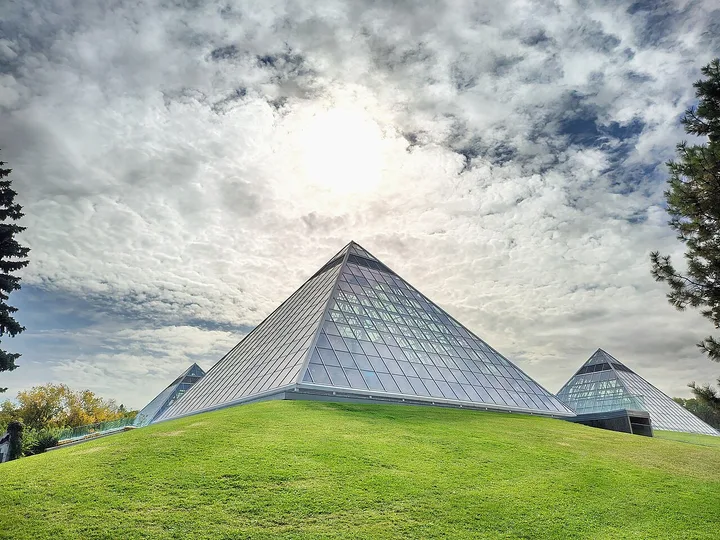
12. Edmonton keeps its plants in glass pyramids. Its four pyramids in the river valley hold about 700 kinds of plants, one of the largest indoor plant collections in Canada.
13. Fort Edmonton Park is one of Canada's largest living history museums. It covers 64 hectares and began as a Canada centennial project in 1967 to rebuild the old fort. Visitors can now walk through an 1846 fur trade fort and streets set in 1885, 1905 and 1920.
Sources: West Edmonton Mall, The Canadian Encyclopedia · Edmonton, The Canadian Encyclopedia · Muttart Conservatory, City of Edmonton · Fort Edmonton Park, City of Edmonton
Festivals, famous people and firsts
14. The Edmonton Fringe is the biggest in North America. Running since 1982, it is the largest and longest-running fringe theatre festival in North America, and Fringe artists keep 100 per cent of net ticket revenue.
15. Edmonton calls itself Canada's Festival City for a reason. Dozens of arts and cultural festivals run each year, and K-Days traces its origins all the way back to an agricultural fair in 1879.
16. Marty McFly is from Edmonton. Michael J. Fox, star of Back to the Future, was born in Edmonton on June 9, 1961.
17. So is half of Cheech and Chong. Comedian Tommy Chong was born in Edmonton on May 24, 1938, though his family moved to the Calgary area when he was young.
18. And the captain of Firefly. Nathan Fillion, star of Castle and Firefly, was born in Edmonton on March 27, 1971.
19. The University of Alberta was open to women from day one. Its founding act banned any course or program not open to women, and its first graduate, in 1912, was a woman, Decima Robinson. Classes began in 1908 with 45 students and five professors.
Sources: About Fringe Theatre, Edmonton International Fringe Theatre Festival · Edmonton, The Canadian Encyclopedia · Michael J. Fox, The Canadian Encyclopedia · Tommy Chong, The Canadian Encyclopedia · Nathan Fillion, The Canadian Encyclopedia · University of Alberta, The Canadian Encyclopedia
Hockey, games and oil
20. The Oilers were the first WHA team to win the Stanley Cup. In 1984 they beat the four-time champion New York Islanders, and they went on to win five Stanley Cups. Wayne Gretzky was part of four of them before his famous 1988 trade to Los Angeles.
21. Commonwealth Stadium was built for a games, then grew for another. It opened for the 1978 Commonwealth Games and was expanded to 60,000 seats for the 1983 World University Games.
22. Alberta's oil boom began just outside the city. The Leduc No. 1 well, southwest of Edmonton, struck the huge Leduc oil field on February 13, 1947. By the end of that year about 30 wells were producing 3,500 barrels a day.
Sources: Stanley Cup champions 1980 to 1989, NHL.com · Edmonton Oilers, The Canadian Encyclopedia · Wayne Gretzky, The Canadian Encyclopedia · Edmonton, The Canadian Encyclopedia · Leduc, The Canadian Encyclopedia
Edmonton fun facts at a glance
| Year | Fact |
|---|---|
| 1879 | The agricultural fair that became K-Days begins |
| 1891 | The railway from Calgary stops at Strathcona, across the river |
| 1908 | University of Alberta classes begin |
| 1912 | Strathcona and Edmonton merge |
| 1914 | Population peaks at 72,516 before a wartime drop |
| 1947 | Leduc No. 1 strikes oil |
| 1978 | First LRT line and the Commonwealth Games |
| 1981 | West Edmonton Mall opens its first phase |
| 1982 | First Edmonton Fringe Festival |
| 1984 | Oilers win their first Stanley Cup |
Sources: Edmonton, The Canadian Encyclopedia · University of Alberta, The Canadian Encyclopedia · Edmonton facts and figures, City of Edmonton · Leduc, The Canadian Encyclopedia · West Edmonton Mall, The Canadian Encyclopedia · About Fringe Theatre, Edmonton International Fringe Theatre Festival · Stanley Cup champions 1980 to 1989, NHL.com
Questions about Edmonton trivia
Why is Edmonton called Edmonton?
Fort Edmonton was reputedly named after Edmonton, now part of London, England, the birthplace of a deputy governor of the Hudson's Bay Company.
Was West Edmonton Mall the biggest mall in the world?
Yes. Guinness listed West Edmonton Mall as the world's largest shopping centre for 24 years, and it remains one of the largest in North America.
How big is West Edmonton Mall?
The mall covers 49 hectares and encloses 493,000 square metres of space, about the area of 104 football fields.
Why is Edmonton called Festival City?
Edmonton hosts dozens of arts and cultural festivals every year, including the Fringe, the Folk Music Festival and K-Days, which earned it the nickname Canada's Festival City.
Is the Edmonton Fringe the largest in North America?
Yes. The Edmonton International Fringe Theatre Festival, first held in 1982, describes itself as the largest and longest-running fringe theatre festival in North America.
Source: About Fringe Theatre, Edmonton International Fringe Theatre Festival
How many Stanley Cups have the Oilers won?
The Edmonton Oilers have won five Stanley Cups, the first in 1984.
Which famous people are from Edmonton?
Actors Michael J. Fox and Nathan Fillion and comedian Tommy Chong were all born in Edmonton.
When did Edmonton get light rail?
Edmonton opened its first LRT line in 1978, the first medium-sized Canadian city to do so.
What is Edmonton's official flower?
The marigold. The City says it represents sunny Alberta and Edmonton's role in the Klondike Gold Rush of the 1890s.
When was oil found near Edmonton?
The Leduc No. 1 well struck the Leduc oil field southwest of Edmonton on February 13, 1947.
Source: Leduc, The Canadian Encyclopedia